Margaret Ngai, Chief Technology Officer of independent agency RI, explores how brands can flourish using a balanced approach to AI implementation.
Emerging from the fog of hype surrounding AI, marketers can look forward to a more clearly defined future. New research from RI titled AI For Growth: How Progressive Marketers are Moving Beyond Just Efficiency finds that technology when viewed as a shortcut to savings does not drive real business growth.
The paper highlights how marketers have moved beyond the experimentation phase at a time when AI investment in marketing is projected to more than double between 2025 and 2028.
The AI growth gap
Almost all CMOs name Generative AI as a spending priority even with flat budgets. Yet there’s still a recognition issue because most of that energy is still aimed at productivity – reducing content production hours or automating workflows – instead of measurably improving purchase intent or customer value.
RI’s research, drawing on millions of social data points, shows that “more AI” does not automatically translate into stronger growth. Brands that take a balanced approach to implementing AI are most likely to influence prospects and customers to buy more.
What consumers actually reward
The study found that consumers still buy more from brands that excel at familiar fundamentals – consistent branding, engaging content, trust and genuine personalization across their journey. AI is welcomed when it makes messages clearer and more relevant, but not when it simply floods people with more volume or gimmicky executions.
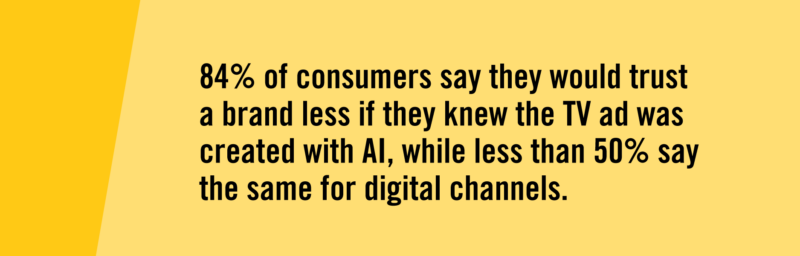
Trust remains at a critical juncture. Consumers are almost evenly split on whether their trust would fall if they knew marketing was written by AI, and the impact varies sharply by channel. Some 84% of consumers say they would trust a brand less if they knew the TV ad was created with AI, while less than 50% say the same for digital channels – a warning for anyone thinking that a fully AI‑generated spot is a shortcut to fame.
Making AI maturity pay
The biggest opportunities for improvement are at the extreme ends of AI maturity, suggests RI’s analysis of brands across categories with different purchase lifecycles Brands with the strongest link between marketing and purchase intent were the most likely to sit on the mid-maturity band.
Meanwhile, early‑stage brands underuse AI and leave efficiency and insight on the table, while some of the most advanced AI organizations fail to outperform on purchase intent because they are scaling ordinary marketing just as efficiently as great marketing.
This echoes a classic Harvard Business Review study of past recessions, which found that companies that flourish after downturns follow a balanced “progressive” playbook rather than slashing costs or investing blindly.
How brands can flourish in 2026
For Canadian marketers facing cost pressure and flat budgets, the opportunity is to shift from AI as a cost efficiency driver to AI as a disciplined driver of customer growth. We have identified three practical ways to achieve that:
1. Grow the fundamentals with better intelligence
Beyond simply using AI as part of an agency workflow, intelligent businesses harness AI to help deliver smarter strategies to clients. For example, we can tap into AI-driven research tools to derive and predict consumer reaction to creative and then incorporate those insights into audience segmentation and communications plans to maximize results.
For brands, this means designing customer journeys that are truly relevant for customers based on their signals rather than relying on human intuition or gut feel. It also requires prioritizing lower‑risk, higher‑learning channels such as email, owned digital and social for AI‑assisted creative and testing, before pushing AI‑heavy work into high‑scrutiny formats like broadcast.
2. Grow through a progressive investment strategy
CMOs should consider quantifying the efficiency upside of AI and then deliberately reinvesting that time and money into growth‑focused initiatives. If a team saves hours each week via AI‑assisted production, it’s possible to redirect that capacity toward higher‑value work like journey optimization, segmentation or new test cells.
In practice, that can include: identifying opportunities for AI-assisted one-time campaign workflows and then re-directing resources to triggered programs that address “moments that matter” in the customer journey. It can also involve using AI to accelerate analytics and scenario planning so that marketing leaders can make faster, evidence‑based decisions on offers, creative, cadence and channel mix.
3. Grow from pilots to playbooks
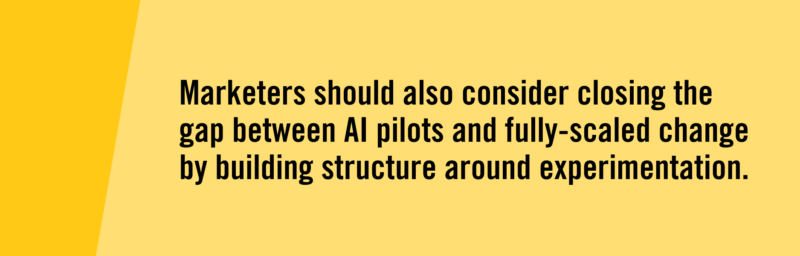
Marketers should also consider closing the gap between AI pilots and fully-scaled change by building structure around experimentation. This means that each AI initiative is framed with a clear hypothesis, success metrics and a go/no‑go decision framework, with a senior owner accountable for rollout if the test wins. For example, RI runs an internal AI Council that brings together cross-client representatives from strategy, creative, data and production to share learnings, align on standards and surface new cross‑functional opportunities.
For clients, that model translates into governance that makes AI usage safe, transparent and on‑brand. It also leads to the creation of reusable playbooks that include templates for AI‑assisted subject line testing, dynamic offer selection or predictive direct mail targeting, which can be rolled out across teams and business units.
Why the right AI focus matters now
RI’s research shows that brands in the “middle” of AI maturity, those that build focused pilots and capabilities, are most likely to see their marketing lift purchase intent. This finding should encourage marketers to prioritize how deliberately AI is applied to strengthen core marketing fundamentals rather than focusing on the sophistication of their tech stack. It’s a simple reframing that will turn AI from a productivity booster into a driver of durable growth.
RI is a member of the Institute of Canadian Agencies (ICA). Report on Marketing is where leading Canadian agencies showcase their insights, cutting-edge research and client successes. The Report on Marketing provides a valuable source of thought leadership for Canadian marketers to draw inspiration from. Find more articles like this in the Report on Marketing.
See all Ideas & Insights