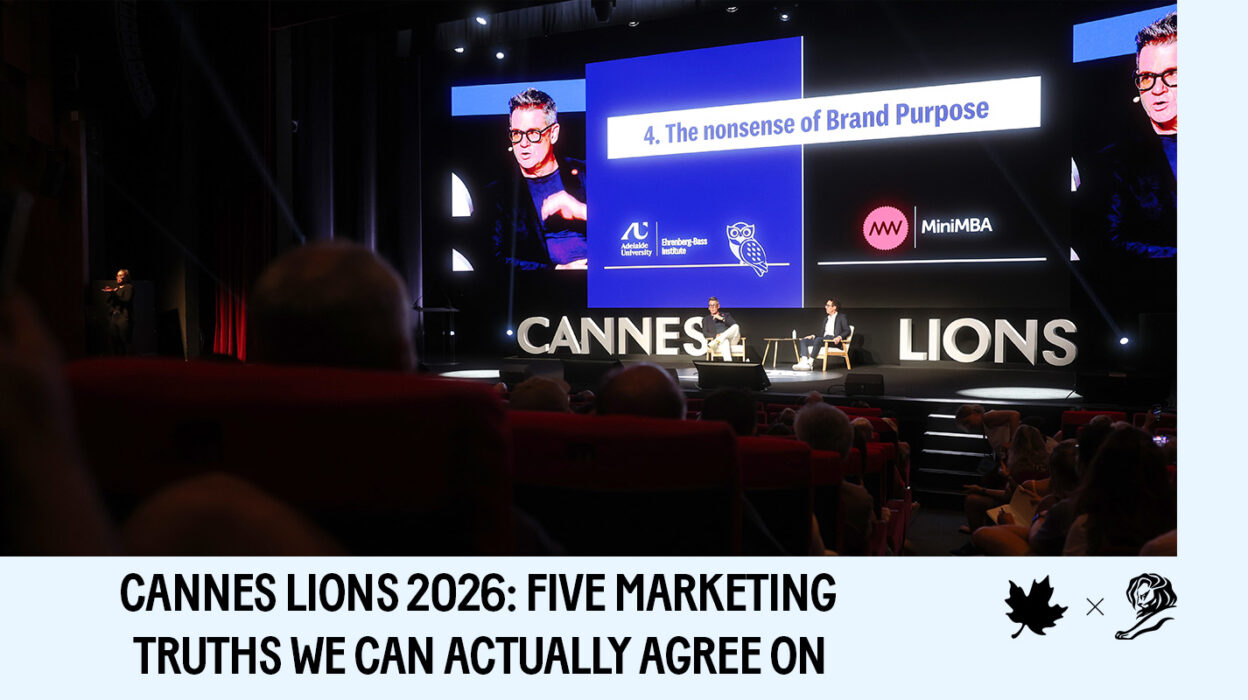
It’s been about a week since the world’s largest marketing festival took place on the shores of the French Riviera, and some moments are still on our minds. One of those moments came during Five Marketing Truths We Can Actually Agree On, which delivered exactly what the title implies: Mark Ritson and Byron Sharp finally agreeing on something – five things, in fact.
Sharp is the director of the Ehrenberg-Bass Institute, and Ritson is the founder of MiniMBA, and the two have a long history of contrasting opinions, some of which show up in this session. That includes topics like whether brands should seek to differentiate, if customer targeting has a place in marketing strategies, or if marketers should worry about brand image. But beyond these differences, Ritson and Sharp did actually find five points that they both agree on. And for marketers, these five truths serve as a helpful reminder of some of the most influential marketing ideas of the past few decades.
1. Mental Availability
This first principle, Sharp explained, represents one of the great shifts in marketing in recent years. In the ’90s, marketers saw brand awareness as a gateway to things like brand image, brand relationships, and brand emotions. However, with Mental Availability, Sharp and the Ehrenberg-Bass Institute brought a new focus: marketers shouldn’t worry about what comes to mind when people think of their brands, but that their brand comes to mind at all.
“If you are mentally available,” Ritson explained, “70–80% of your job has been done.” Since consumers see hundreds of brands every day, they have, as Ritson puts it, “three seconds and two brain cells” to give to your brand. So if your audience has your brand in their head, you’ve already won the battle.
2. Distinctive Brand Assets
To build Mental Availability, marketers need to build a distinctive brand. However, the key difference between Sharp’s concept, Distinctive Brand Assets, and the traditional approach, is that it’s not about creating a complicated brand image, but a simple collection of assets that make your brand immediately recognizable.
Sharp explained that one of the most common misconceptions with Distinctive Brand Assets is that many marketers think their brand has to be “green when everyone else is purple.” Instead, it’s about just looking like you, even if that’s quite beige. Ritson agreed, sharing one of his favourite Byron Sharp quotes: “A brand that looks like itself.”
Ritson admitted that one of the problems with Distinctive Brand Assets is that he and Sharp have different terms for the same thing. What Ehrenberg-Bass calls Distinctive Brand Assets, Ritson calls Brand Codes, and System1 calls Fluent Devices. To support clear terminology, Ritson pledged that MiniMBA would now retire its language and adopt Ehrenberg-Bass’ Distinctive Brand Assets. It was a heartwarming gesture for the marketing community.
3. Resurrection of Mass Marketing
In the traditional, Kotlerian approach to marketing, hyper-targeting had reached its inevitable conclusion: niching down so radically that you cut out entire segments of your audience. Both Ritson and Sharp believe that mass marketing is still relevant and vital, but with a small caveat. Sharp calls it Sophisticated Mass Marketing – an approach that supports broad messaging but still leaves room for slight variation for geography, language, and audience. Sharp explained, “You’re still trying to reach everyone, but you’re not treating everyone as exactly the same.”
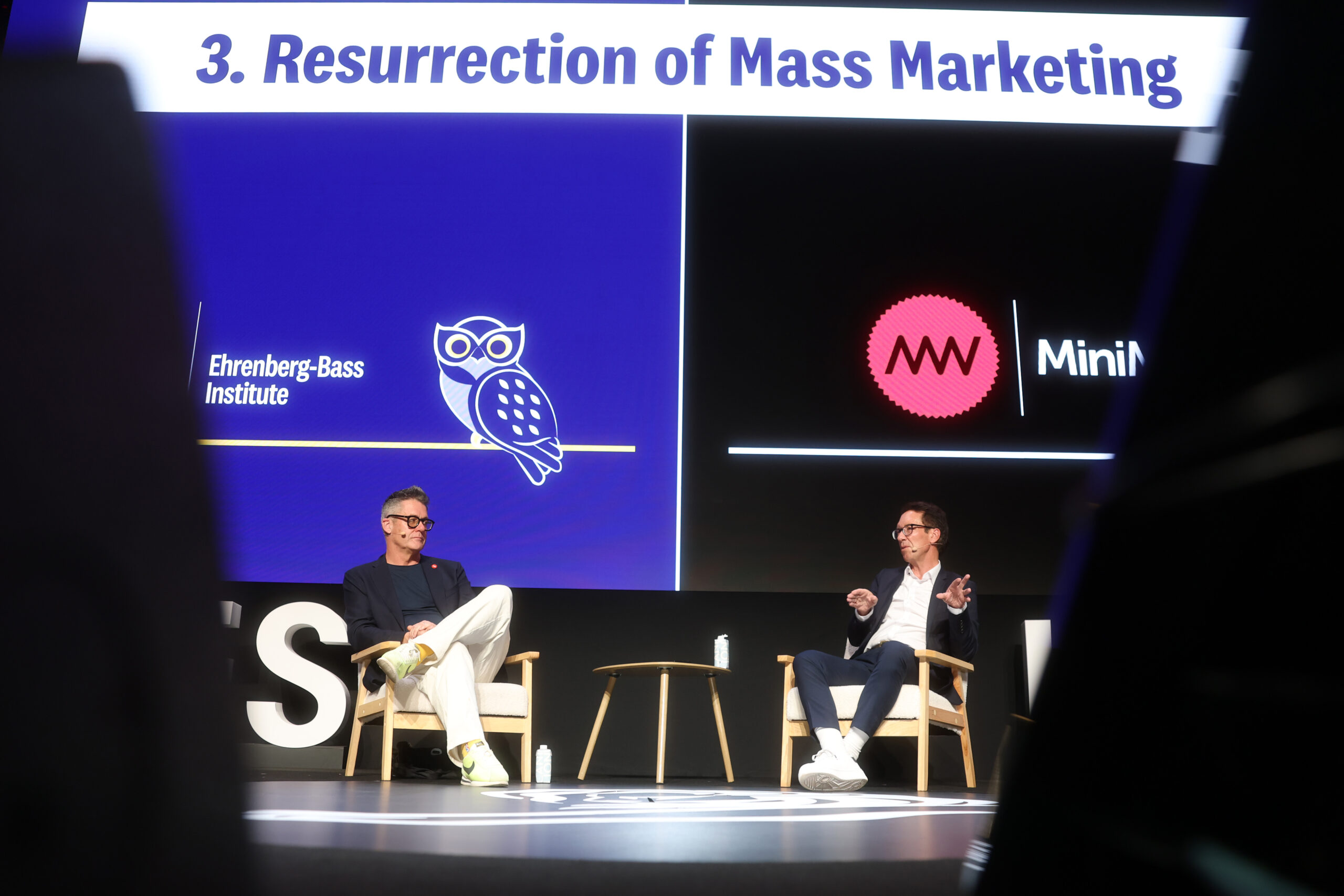
However, Ritson and Sharp didn’t totally agree on this marketing truth. Ritson’s approach, Two-Speed Marketing, supports mass marketing with specific targeting at the decision-making level. Sharp, however, felt that this isn’t targeting at all, but just purchase availability. Practically, their methods were the same, but their terminology clashed.
4. The Nonsense of Brand Purpose
Both Ritson and Sharp have agreed on one truth for at least a decade: that brand purpose is nonsense. Ritson explained that, except for a few outlier companies, consumers don’t buy your product for its social stance, or as he put it, no one cares about your toothbrush and how it feels about racial equality. And since both Ritson and Sharp believe that marketers should focus on Mental Availability, they see brand purpose as a superfluous extension of brand image that doesn’t do anything for your business.
5. Consistency
Both Ritson and Sharp agree on brand consistency, but so does everyone else. Even so, the work at Cannes continues to get less consistent. Ritson mentioned that campaign runtimes are getting shorter and shorter, even though good data shows that you have “two or three years to get the most from [campaigns].” He challenged the audience to “leave your cakes in the oven for longer.” Sharp finds that marketers massively overestimate how many people see their ads, and believes that going longer with your campaigns ensures more reach and ultimately, better Mental Availability.
Ritson and Sharp ended with a heartwarming acknowledgment of their decades-long friendship: “We’ll go out together,” said Ritson, “and I couldn’t think of anyone nicer or more annoying to go through it with than you, B.” A satisfying start to the week that’ll go down in Cannes history.