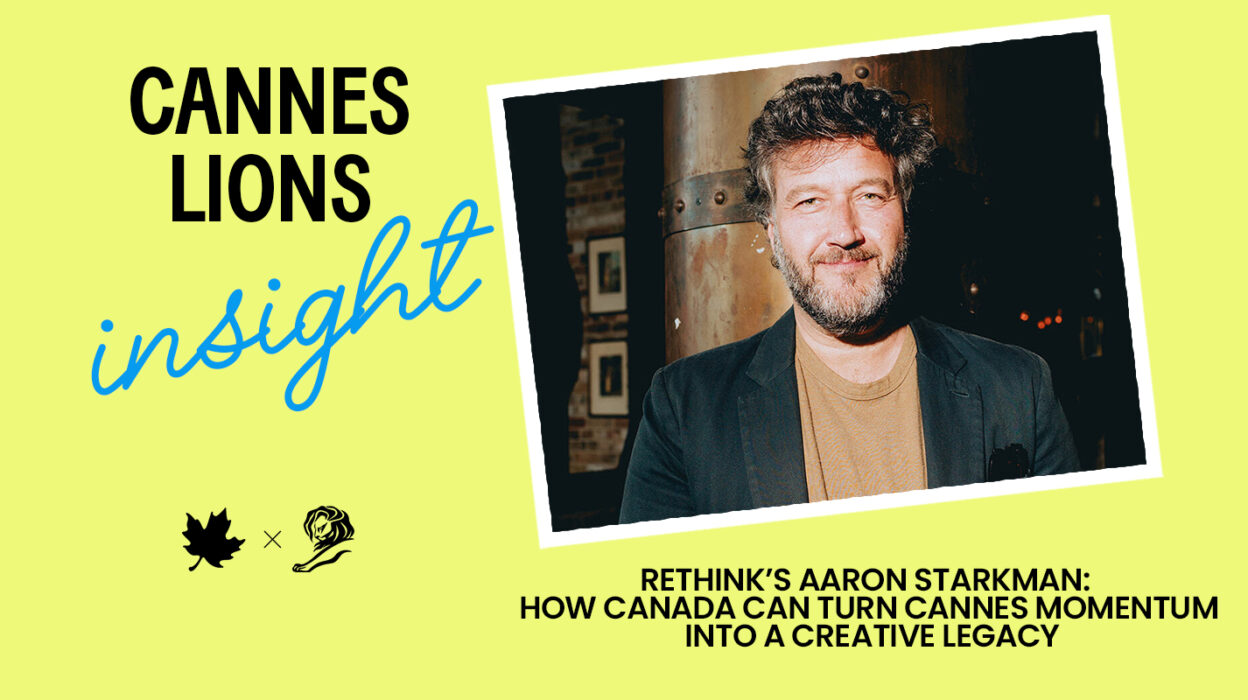
Canadian agencies have proven they can compete on the global stage. As the first-ever agency to finish as a top-three independent network at Cannes Lions for five consecutive years, Rethink has become one of the clearest examples of Canada’s creative strength. And Ad Age agrees – the publication just named Rethink the number-one agency of 2026. Before he jumped on a flight to Cannes, we spoke with Aaron Starkman, Rethink’s Global Chief Creative Officer and this year’s Jury President for Outdoor Lions, about why great work doesn’t happen by chance – it’s the result of the right culture, the right relationships and the right conditions for ambitious ideas to thrive.
Canada has had real momentum at Cannes. What does it take to make that momentum repeatable, not occasional?
You have to stop treating great work like a miracle and start treating it like a system. The countries that win consistently aren’t necessarily more talented; they create conditions where creativity can thrive consistently. They protect interesting ideas longer. They push for sharper thinking. And there’s a belief across the entire organization, from strategy to account management to production to PR, that creativity is the most powerful driver of business growth.
The repeatability comes when leaders continue building those environments. Building brands people actually care about. Championing ambitious thinking. And recognizing that the work people remember and share is usually the work that moves business forward too.
Rethink has helped prove Canadian work can lead globally. What should Canada be more confident about right now?
Our perspective. We’re close enough to the U.S. to understand mass culture, but far enough away to look at it differently. That vantage can create sharper observations and fresher creative instincts.
Canadian agencies have never really had the luxury of spending our way out of business problems with massive productions or celebrity budgets. Ideas became king out of necessity.
That has fostered a certain discipline around strategic thinking, craft and clarity. A lot of the best Canadian work doesn’t scream for attention. It has confidence in the idea.
Canada also has some of the best creative client relationships in the world right now. There’s a real openness to use creativity as a genuine business tool, not just marketing wallpaper. When that trust exists, Canadian agencies can compete with anyone.
What’s something younger creatives understand better than leadership?
Sometimes leadership still evaluates ideas as if audiences are patiently waiting to receive advertising. They’re not. People are swiping past hundreds of pieces of content every day. If something doesn’t create an immediate emotional reaction – curiosity, tension, laughter or surprise – it basically doesn’t exist. Younger creatives grew up inside the feed, so they instinctively understand what earns attention, what gets skipped, what feels manufactured and what actually feels culturally alive.
They’re also much less interested in traditional advertising formats. Younger creatives naturally think in terms of participation, culture, creators, earned media and ideas that can move fluidly across platforms instead of feeling trapped inside campaigns.
The best agencies are the ones where leadership brings judgment, experience and perspective, but the next generation influences the rhythm, energy and cultural instincts of the work.
You talked about Canadian clients being uniquely open to creativity as a business tool. What did the agency side do over the last decade to earn that trust?
Trust has come from small wins that unlock bigger opportunities. Sometimes it’s a social post that gets attention, creates conversation, earns media and shows a client that an idea can move people. It doesn’t always start with the massive campaign or the biggest bet.
Those moments build confidence. They give clients the proof that creativity can create real impact. Then the opportunities get bigger, the trust grows and the relationship evolves.
The best work feels inevitable for the brand. When you see it, you think, “Of course they did that.” That’s the standard we’re chasing.
You’re heading into Cannes as Outdoor Lions Jury President. Without giving anything away, what’s the question you’ll be asking yourself as you judge?
The best work has that magic where you see it and immediately understand why that brand had to make it. It feels like the perfect intersection of an idea, a brand and the cultural moment.
And when that happens in Outdoor, it’s incredibly powerful because it’s one of the oldest mediums in advertising. It exists in the real world, in front of real people, and there’s no hiding behind a screen. The work has to connect.
We’re looking forward to awarding the best of the best.
Last year’s Cannes had a clear AI conversation running through it. What do you think the 2026 conversation in the jury room is going to be about?
Last year there was a lot of fear and uncertainty about AI. There was a real question about what it meant for our industry and whether it would change everything.
I think that moment has passed. Over the last year, people have embraced AI in a much more practical way. Everyone has their AI intern now. It’s become part of everyday life, just like every other major technology shift we’ve experienced.
And I think there’s been a quiet sense of relief. A year ago, the conversation felt very anxious. Now it feels much more like: “How do we use this to make better work?”
You’ve been doing this long enough to see more than one “this changes everything” moment. What did the previous ones teach you about how to navigate the Age of Intelligence?
Every generation has had its pivotal moment: We’ve seen it with the internet, social media, mobile and every major technology shift along the way. The lesson is that the tools change the process, but they don’t change the fundamentals: The need for great ideas and understanding people stays the same.
The people who navigate these moments best are the ones who embrace the new technology without losing sight of the craft. AI is a tool, and a powerful one, but it still comes down to human creativity, judgment and the ability to create something that actually means something to people.
What’s one small thing a Canadian creative leader could do at Cannes that would immediately elevate their approach to work?
Go look at the work! And don’t just look at the obvious stuff. Don’t just show up and watch a few Gold Lions case study videos. Go deeper. Look at the Bronzes. Look at the shortlist. Go in the basement and nerd out. Study why things work. Understand what is resonating with people around the world.
Then bring that learning back to Canada. We have an incredible creative community here. We should keep pushing ourselves, keep learning and continue to kick ass on the world stage.